Digital Pharma: Big pharma’s iPhone apps (part three)
pharmafile | July 7, 2010 | Feature | Medical Communications, Research and Development, Sales and Marketing | Apple, Digital Pharma blog, app, ipad, iphone
In the first two parts of Big Pharma’s iPhone Apps I looked at apps produced by 11 of the largest pharmaceutical companies.
Read Part One here and Part Two here.
Between them they’ve produced 39 apps focused on the ethical pharma side of their business, with apps for patients diaries, disease awareness, disease prognosis, calculating medicine doses and finding clinical trials.
I limited myself to searching out prescription product focused apps produced by big pharma. So, amongst others, there was no room for the pollen related apps variously produced by Schering-Plough in the UK, sponsored by Sanofi-Aventis in Ireland this summer or available from Johnson & Johnson in the US.
Neither was there space for GSK’s German alli Food Planner app (pictured above), the Merck Manual apps (produced by Agile Partners) or the Academy2Go app from Novartis eye-care division Ciba Vision, among others.
But Academy2Go deserves a few more words. It features continuing educational courses on contact lenses and clearly illustrates the possibility of CME apps from big pharma.
Overall the number of apps from pharma clearly isn’t huge so far, but they do reveal an industry experimenting with new(ish) technology.
iPhone apps – do users care?
By and large iPhone users are pretty attached to their apps. Given half a chance we’ll jump at the chance to pontificate on the merits on our latest download, and this shows on the iTunes Store.
If users like your app they’ll give it a star rating and review it. The reviews may often be moans about how the latest update isn’t working properly, but popular apps have no problem attracting ratings and reviews.
On these, admittedly pretty crude terms, pharma’s iPhone apps are not working. They’re just not very popular. Pharma apps are generally not rated on the iTunes Store and very, very rarely are they reviewed.
But is this a problem? The audience for, say, Schering-Plough’s UK Bridion dosing calculator is pretty a pretty niche one, particularly when compared to Healing Crystals – the number one free ‘medical’ app at the moment.
Still, with InPharm recently having looked at digital engagement, it would be nice to see more signs of user engagement with pharma’s apps on the iTunes store.
There are one or two isolated examples of this. Take GSK’s alli Food Planner app, for example. The German language app for the company’s over-the-counter weight loss aid not only has reviews, but every one of them likes the look of it so much they want to see an English version produced.
iPhone therefore iPad?
Perhaps one of the most exciting thing about iPhone apps is their potential, and this potential is often perceived to come in the shape of the iPad, the three millionth of which was sold after just 80 days on the market.
Almost all the 225,000 iPhone apps will run on an iPad, and the larger device already has over 11,000 apps that have been created specially for it. Of these, the healthcare iPad apps that have been grabbing all the attention, see the article 25 iPad Apps Revolutionizing Healthcare for some great examples of this, have so far not come from pharma. But that’s not to say they couldn’t.
There are already the beginnings of an iPhone to iPad transition for pharma apps, with Pfizer’s Mon Krono Sante and Sanofi-Aventis’ GoMeals apps leading the charge. So it’s no wonder there’s a general air of anticipation among digital marketing types to get some figures on iPad uptake among doctors.
Where iPhone leads, iPad may follow
Getting back to the iPhone, it’s fair to say the devices are already proving to be very popular for accessing health information.
In December 2009 the Department of Health said the five most popular ‘mobile phones’ (really devices if they’re including the iPod touch, but let’s not split hairs) for accessing NHS information via the internet were:
• iPhone – 61%
• iPod Touch – 17%
• Nokia 5800 – 2.75%
• Nokia e71 – 2.11%
• Blackberry – 4%
So that’s 78% of people who currently access health information via their mobile for whom a healthcare app might be suitable – if it appeals to them enough.
Granted, the statistics didn’t say whether they referred to patients or prescribers, or both. But since it accompanied the launch of the NHS’ ‘booze app’ for counting alcohol units, it seems reasonable to assume they’re talking about patients.
Standout pharma-related apps
Before I conclude I want to mention two of my favourite pharma-related apps.
The first is the Merck PSE app from the chemicals arm of Merck KGaA. It’s a periodic table app, ideal for students, that draws you in with an appealing design and intuitive ease of use.
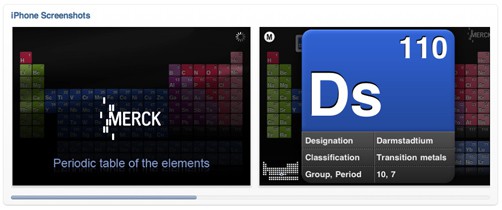
Ok, so it’s not that often I’m on the move and have a pressing need to know the discoverer of, say, Erbium or its melting point (Swedish chemist Carl Gustav Mosander and 1497°C if you’re interested). But I think the app shows some of the possibilities for well-designed medical education apps.
The other is the drug information app Epocrates. Here it’s not so much the app itself as Pfizer’s partnership with Epocrates, which shows pharma doesn’t always have to reinvent the wheel when it comes to the iPhone by choosing an app that seems genuinely popular. It’s the 39th most downloaded free medical app on the UK iTunes (which isn’t bad when you’re up against Healing Crystals!) and Epocrates says around one in five US physicians actively use its app on their iPhone or iPod touch.

Pfizer’s collaboration will allow users viewing some 40 Pfizer drug profiles on the app to contact the company directly if they have any questions about them.
One channel among many
iPhone and iPad apps are, much like social media, a worthwhile channel but just one of many, and they won’t be right for everyone.
But, as the 78% of mobile online NHS surfers and the three million iPad owners attest, there’s certainly enough potential in apps to legistimise some of the iHype. Plus, when you stop fixating on Apple’s products things really start to get interesting.
Despite its marketing presence, the iPhone is just one app-running smart phone of many, competing for market share alongside various models from Blackberry, Nokia, Palm and even Google (whose Nexus One was launched in January).
In fact, in the first three months of this year the iPhone accounted for about 15% of global smart phone sales, ahead of the Nexus One (10%) but behind Blackberry (19%) and phones, such as the Nokia 5800, that run on the popular Symbian platform (44%).
Smart phone ownership is already common among doctors, but their use is currently often restricted to accessing clinical content and performing simple tasks. However, industry analysts Manhattan Research say that within the next two years 81% of US doctors will own a smart phone (up from 64% in 2009), and that about half of this group will use their devices for administrative functions, learning, and patient care.
The iPhone and iPad may grab all the headlines, but perhaps we should be thinking more inclusively in terms of smart phones when it comes to tapping into the potential apps offer as a channel for pharma.
• Read Part One of Big Pharma’s iPhone Apps here and Part Two here.
Dominic Tyer is web editor for Pharmafocus and InPharm.com and the author of the Digital Pharma blog He can be contacted via email, Twitter or LinkedIn.

Related Content

NHS-integrated pharmacy app Charac receives £1.2m funding
Charac, an NHS-integrated pharmacy app, has raised £1.2m in debt and equity financing from the …

COVID-19 track and trace app launched in England and Wales after months of delays
The UK Government’s track and trace app for COVID-19 has finally launched in England and …

New Johnson & Johnson study aiming to add stroke detection to Apple Watch
Johnson & Johnson announced that Janssen Pharmaceuticals will work in collaboration with Apple to explore …