Novartis blood cancer drug Farydak receives EU approval
pharmafile | September 4, 2015 | News story | Sales and Marketing | Cancer, European Commission, Farydak, Novartis, multiple myeloma, myeloma, panobinostat
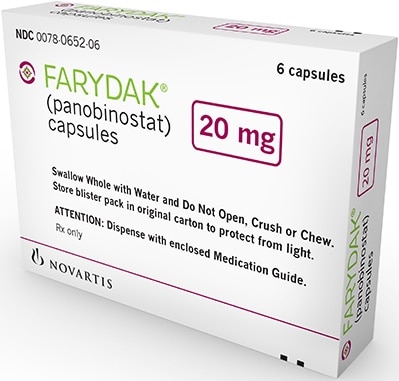
The European Commission has approved Novartis’s Farydak, in combination with Velcade and dexamethasone, for the treatment of adult patients with relapsed and/or refractory multiple myeloma.
The approval means Farydak (panobinostat, previously known as LBH589) becomes the first histone deacetylase (HDAC) inhibitor with epigenetic activity available in the European Union. It is believed that as an HDAC inhibitor, its epigenetic activity may help restore cell function in patients with multiple myeloma.
Multiple myeloma is a cancer of the plasma cells- a type of white blood cell present in the bone marrow- which affects approximately 84,000 people in Europe. Farydak is the first HDAC inhibitor to show efficacy in treating the condition.
Bruno Strigini, president of Novartis Oncology, comments: “With the approval of Farydak in the European Union, we hope to address critically important treatment needs faced by the multiple myeloma community-disease progression and treatment resistance. This milestone, the approval of a first in its class treatment option for patients in need of new therapies, is the result of more than 13 years of dedicated research, which has helped us better understand the development of multiple myeloma.”
The EU approval of Farydak is for people who have received at least two prior regimens including bortezomib and an immunomodulatory agent (IMiD). It is based on a Phase III Panorama-1 trial of 147 patients who had received at least two prior regimens, including Velcade (bortezomib) and an IMiD.
The trial found that the median progression-free survival (PFS) benefit increased by 7.8 months in these patients, as compared to the placebo arm. But more than a third of patients stopped treatment due to adverse events, most commonly diarrhoea (4.5%), fatigue (2.9%) and pneumonia (1.3%).
It was due to these adverse events that Farydak endured a bumpy road to approval in the US, with the FDA initially rejecting the drug for treatment of relapse multiple myeloma in November 2014. The regulatory body later changed its mind based on additional information supporting the Farydak, bortezomib and dexamethasone combination.
Even now, however, Novartis says Farydak’s continued approval in the US may be contingent upon verification and description of clinical benefit in confirmatory trials. It is also subject to a Risk Evaluation and Mitigation Strategy (REMS).
Joel Levy
Related Content

Scotland starts newborn screening for SMA
As part of a two-year evaluation funded by the Scottish government and Novartis, Scotland will …

Sobi’s Aspaveli receives European Commission approval for treatment of two rare kidney diseases
Sobi has announced that its Aspaveli (pegcetacoplan) has received approval from the European Commission (EC) …

Novartis receives SMC approval for early breast cancer treatment
Novartis has announced that its treatment for early breast cancer, Kisqali (ribociclib), has received approval …