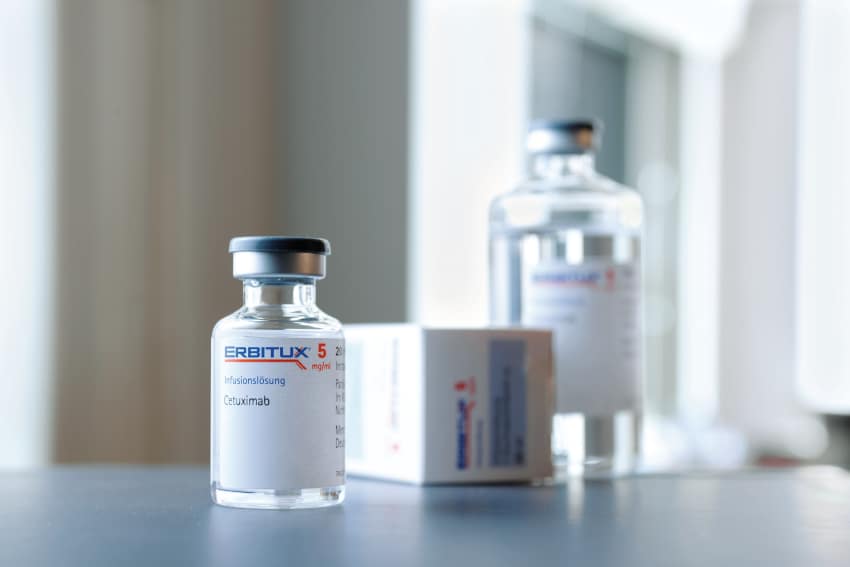
Merck re-submits Erbitux to the EMA for lung cancer
pharmafile | March 30, 2011 | News story | Sales and Marketing | EGFR, Erbitux, Iressa, Merck KGaA, NSCLC, Tarceva, lung cancer drugs, non-small cell lung cancer
Merck KGaA has re-submitted Erbitux’s lung cancer licence extension to the EMA after its first application to the regulator was knocked back two years ago.
Merck has now applied for a narrower indication as a first line treatment for non-small cell lung cancer patients in combination with a platinum-based chemotherapy agent, but only if they express the epidermal growth factor receptor (EGFR).
Merck first submitted Erbitux (cetixumab) as a first-line lung cancer treatment, irrespective of a patient’s EGFR status.
After the EMA’s Committee for Medicinal Products for Human Use (CHMP) ruled in July 2009 that its benefits did not outweigh its risks, Merck worked on personalising the treatment to EGFR positive patients.
To support its latest application the company has produced a new biomarker analysis of EGFR expression levels in tumours of patients participating in the phase III FLEX trial.
This saw EGFR patients’ response rates significantly increase after the addition of Erbitux to chemotherapy – rising from 28.1% to 44.4%, and Merck said further clinical trial data would be presented at upcoming medical congresses.
But approval in this indication will limit the drug’s sales potential, as only around 10% of all non-small cell lung cancer (NSCLC) patients in Europe express EGFR.
Erbitux is already licenced to treat EGFR expressions of metastatic colorectal cancer and for locally advanced squamous cell carcinoma in the head and neck.
In 2008 the drug received an additional European licence to treat the KRAS wild-type mutation in colorectal cancer.
From these indications Erbitux made Merck 820 million euro in sales last year, an 18% increase on its 2009 performance.
EGFR drugs for lung cancer
There are already a number of drugs on the European market for EGFR expressions of NSCLC.
The current standard of treatment in Europe is AstraZeneca’s Iressa, which is licensed as a first line treatment in combination with a doublet chemotherapy regime, and made the company $393 million in sales last year.
Roche’s Tarceva is hot on its heels and is set to receive a first line indication in Europe after recent phase III studies showed it could extend progression-free survival by an average of 3.3 months for EGFR patients.
Tarceva is currently licensed for either second line treatment or maintenance therapy for metastatic NSCLC irrespective of EGFR status.
Ben Adams
Related Content

HUTCHMED completes enrolment in phase 3 trial for lung cancer
HUTCHMED has completed patient enrolment for the SANOVO phase 3 clinical trial, investigating the use …

FDA grants accelerated approval for advanced non-small cell lung cancer treatment
The US Food and Drug Administration (FDA) has granted accelerated approval to Dizal Therapeutic’s Zegfrovy …

Combination first-in-line treatment approved for patients with non-small cell lung cancer
Johnson & Johnson Innovative Medicine have announced that the European Commission (EC) has approved a …