UK tops Quality of Death rankings
pharmafile | October 6, 2015 | News story | Medical Communications | NHS, ageing population, palliative care
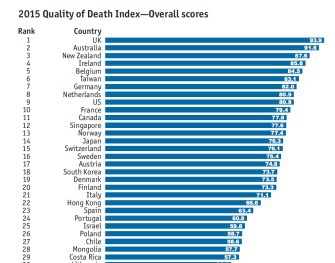
The UK has ranked first in the 2015 Quality of Death Index, a measure of the quality of palliative care in 80 countries around the world released today by The Economist Intelligence Unit (EIU).
The EIU says Britain topped the chart as a result of its comprehensive national policies, the extensive integration of palliative care into the National Health Service, a strong hospice movement, and deep community engagement on the issue.
The UK also came top in the first Quality of Death Index, produced in 2010. The 2015 Index is the second of the five-yearly survey, which has expanded to be composed of scores in 20 quantitative and qualitative indicators across five categories. The categories are:
- Palliative and healthcare environment (20% weighting, 4 indicators)
- Human resources (20% weighting, 5 indicators)
- Affordability of care (20% weighting, 3 indicators)
- Quality of care (30% weighting, 6 indicators)
- Community engagement (10% weighting, 2 indicators)
The Quality of Death Index, commissioned by the Lien Foundation, a Singaporean philanthropic organisation, is based on extensive research and interviews with over 120 palliative care experts from across the world.
Although in comparative terms standards of palliative care in the UK are second to none, there is still room for improvement. An investigation by the Parliamentary and Health Service Ombudsman into complaints about end-of-life care, published in May 2015, highlighted issues such as poor symptom control, poor communication and planning, lack of response to the needs of the dying, inadequate out-of-hours services and delays in diagnosis and referrals for treatment.
Further improvements are also necessary to cope with future demand. EIU analysis of the need for palliative care, accompanying the Index, suggests that with an ageing population and non-communicable diseases like cancer, dementia and diabetes imposing an increasing burden, the need for palliative care in the UK will keep growing.
The provision of better palliative care could also improve the efficiency of healthcare spending. Recent third-party research has demonstrated a significant link in the use of palliative care and treatment cost savings.
This suggests that shifting from strictly curative health interventions to more holistic management of pain and symptoms can reduce the burden on healthcare systems and limit use of costly but futile treatments.
Annie Pannelay, Principal, EIU healthcare, says: “The UK is an acknowledged leader in palliative care, and has kept its position at the top of our Quality of Death Index. That reflects its comprehensive strategy towards the issue, as well the improvements that are being made, for example in ensuring that people get to spend their final days in the place of their choice.
“But there is more that the UK could do to stay at the forefront of palliative care standards, such as ironing out occasional problems with communication or symptom control. This issue will become increasingly important in an ageing population.”
Joel Levy
Related Content

Under-Secretary of State for Health Innovation and Safety visits new building on University of Huddersfield’s NHIC
Dr Zubir Ahmed MP, the Under-Secretary of State for Health Innovation and Safety, has visited …

Digital mental health technologies – a valuable tool in supporting people with depression and anxiety
The potential benefits of digital mental health technology for managing depression, anxiety and stress, together …

A community-first future: which pathways will get us there?
In the final Gateway to Local Adoption article of 2025, Visions4Health caught up with Julian …