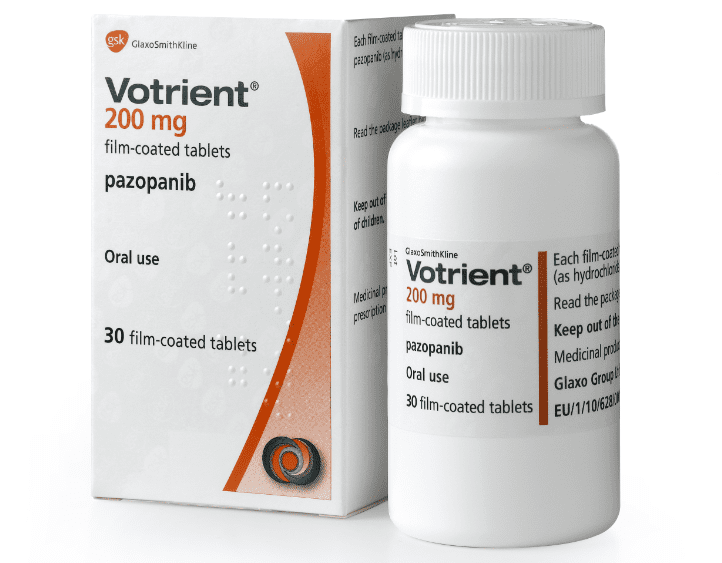
Survival boost for Votrient in mRCC
pharmafile | October 2, 2012 | News story | Research and Development, Sales and Marketing | GSK, Nexavar, Pfizer, Sutent, Votrient
GlaxoSmithKline’s renal cell carcinoma drug Votrient has proved itself non-inferior to a bitter rival, Pfizer’s Sutent, in terms of progression-free survival (PFS).
In the open-label, head-to-head Phase III study COMPARZ, advanced renal cell carcinoma (mRCC) patients treated with Votrient (pazopanib) had a similar PFS to those in the Sutent (sunitinib) arm.
The news confirms Votrient’s status in this therapy area: Sutent is still the market leader but Votrient is challenging hard, and will usurp Sutent by 2016, according to analysts at Decision Resources.
In the COMPARZ trial, whose primary endpoint was PFS, the Votrient versus Sutent hazard ratio for PFS was 1.047 (95% CI 0.898, 1.220) and the predefined criterion for non-inferiority was the upper bound of a two-sided 95% CI of 1.25.
Median PFS was 8.4 months (95% CI 8.3, 10.9) for Votrient compared to Sutent at 9.5 months (95% CI 8.3, 11.1), according to data presented at the ESMO 2012 Congress of the European Society for Medical Oncology in Vienna.
In the study, 1,110 patients were randomised to receive treatment with either drug at their respective, approved treatment doses for four weeks followed by two weeks off treatment.
Treatment continued in both arms until patients showed signs of disease progression, unacceptable toxicity or voluntarily withdrew.
The secondary endpoint showed an objective response rate of 31% in the Votrient arm compared to 25% in the Sutent arm.
Paolo Paoletti, president of GSK Oncology, said: “There has been limited information on the direct comparison of therapeutic agents such as pazopanib and sunitinib and we undertook the study in hopes of providing insights that will support the treatment decisions physicians make.”
Pfizer suffered a blow earlier this year when a Phase III trial found that combining the manufacturer’s Torisel (temsirolimus) with Roche’s Avastin does not increase survival rates for advanced RCC patients.
Pfizer had been hoping to increase its drug’s use by combining it with Avastin, but this now looks unlikely – it also failed to beat Bayer’s RCC drug Nexavar in a head-to-head study.
Adam Hill
Related Content

GSK’s Exdensur receives MHRA approval for asthma and rhinosinusitis
GSK’s Exdensur (depemokimab), a twice-yearly biological medicine, has received approval from the UK Medicines and …
NICE recommends Pfizer’s new once-weekly treatment for haemophilia B on NHS
Walton Oaks, 21st May 2025 – Pfizer Ltd announced today that the National Institute for Health and Care …

Multiple myeloma treatment approved in Japan
GSK’s Blenrep (belantamab mafodotin) combinations have been approved by Japan’s Ministry of Health, Labour and …