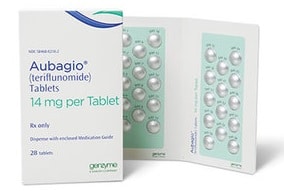
Sanofi MS treatment Aubagio slows brain atrophy in Phase III trial
pharmafile | October 7, 2015 | News story | Research and Development | Genzyme, MS, Sanofi
Sanofi and its subsidiary Genzyme have announced that magnetic resonance imaging (MRI) data from the Phase III TEMSO study demonstrate that Aubagio (teriflunomide) significantly slowed brain volume loss (or atrophy) versus placebo over two years in people with relapsing multiple sclerosis (RMS).
MRI data from TEMSO were analysed utilising SIENA (structural image evaluation using normalisation of atrophy), an alternative methodology than originally used.
Change in brain volume from baseline was assessed in patients treated with Aubagio 14 mg or 7 mg, or placebo. In the MS clinical studies of Aubagio, including TEMSO, the incidence of serious adverse events was similar among Aubagio and placebo-treated patients.
Brain atrophy is the result of the destructive pathological processes that occur in MS. It is seen from the earliest stages of disease and leads to irreversible neurological and cognitive impairment.
These data will be presented on October 10, 2015 at the 31st Congress of the European Committee for Treatment and Research in Multiple Sclerosis (ECTRIMS) in Barcelona, Spain.
Results include a median percent reduction from baseline in brain volume of 0.39, 0.40, and 0.61 for Aubagio 14 mg, 7 mg, and placebo, respectively, by month 12. This change was lower for both Aubagio groups versus placebo: 14 mg by 36.9 percent, p=0.0001; 7 mg by 34.4 percent, p=0.0011.
The difference in reduction of brain atrophy for Aubagio versus placebo was maintained at month 24. Median percent reduction in brain volume from baseline was 0.90, 0.94, and 1.29 for Aubagio 14 mg, 7 mg, and placebo, respectively. This change was lower for both Aubagio groups vs. placebo: 14 mg by 30.6 percent, p=0.0001; 7 mg by 27.6 percent, p=0.0019.
“Control or prevention of brain atrophy is an important target for MS treatment,” says Professor Dr Ludwig Kappos, Neurology chair, University Hospital Basel, Switzerland. “These data help provide further insight into teriflunomide’s potential effects in people with RMS.”
“These results showing the reduction in brain atrophy over two years add to the growing body of data for Aubagio,” adds Bill Sibold, head of Genzyme’s Multiple Sclerosis business. “We remain committed to furthering the understanding of Aubagio and the potential benefits it could deliver to relapsing MS patients.”
Aubagio was approved by the US FDA for treatment of MS in September 2012.
Joel Levy
Related Content

Sanofi and Regeneron’s Dupixent receives CHMP recommendation for chronic spontaneous urticaria
Sanofi and Regeneron have received a positive opinion from the European Medicines Agency’s (EMA) Committee …

Sanofi’s treatment granted orphan designation for rare chronic inflammatory condition
The European Medicines Agency has granted orphan designation to Sanofi’s investigational Bruton’s tyrosine kinase (BTK) …

Sanofi completes acquisition of Vigil Neuroscience to early neurology pipeline
Sanofi has announced that it has finalised its acquisition of Vigil Neuroscience, a US-based biotechnology …