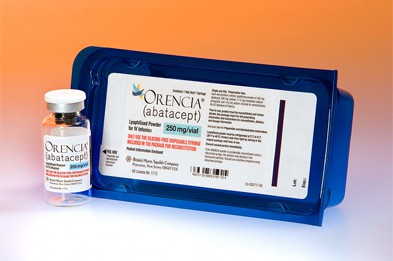
Orencia matches Humira
pharmafile | June 13, 2013 | News story | Sales and Marketing | AbbVie, Abbott, Humira, Orencia, RA
Bristol-Myers Squibb is hoping its biologic Orencia can grab a little more of the rheumatoid arthritis market after demonstrating non-inferiority to AbbVie’s Humira in two-year data from a head-to-head trial.
Orencia (abatacept) showed comparable efficacy to Humira (adalimumab) when both were added to methotrexate (MTX) in patients with moderate to severe RA, in results from the Phase III AMPLE study presented at the European League Against Rheumatism annual congress.
Radiographic non-progression at two years was achieved by 85% of those in the Orencia arm and 84% in the Humira arm, with a similar frequency of adverse events in both.
The results back up what BMS announced last year, when Orencia achieved more or less the same efficacy as Humira in treating RA in biologic-naïve rheumatoid patients with background treatment.
“Results from the second year of the AMPLE study confirm what we saw in year one data,” said principal investigator Michael Schiff. “Namely, that efficacy was comparable for the two agents in this study.”
AMPLE met its primary endpoint as measured by non-inferiority of ACR20 (American College of Rheumatology 20% improvement) at year one, with the Orencia regimen achieving a 64.8% rate of efficacy (Humira: 63.4 per cent).
ACR20 response rates at year two were 59.7% for Orencia plus MTX and 60.1% for Humira plus MTX, while onset of response was generally comparable between the two groups for ACR20, 50 and 70, which are considered more stringent measures.
In all, the trial involved 646 patients and 30.2% in both treatment groups showed a major clinical response (an ACR70 score maintained for ≥6 months) at two years.
A DAS28-CRP score ≤3.2 was achieved by 65.3% of patients in the Orencia arm (Humira: 68%) while 50.6% of patients on Orencia and MTX had a score <2.6 (Humira: 53.3%).
Safety data at 24 months was similar between Orencia and Humira, with frequency of adverse events 92.8% and 91.5%, respectively, while serious adverse events were 13.8% and 16.5% and malignancies were 2.2% and 2.1%.
Originally available as an intravenous infusion, the subcutaneous version of Orencia used in AMPLE will make it more attractive to patients and doctors.
But AbbVie will fight hard for Humira’s position: it is the driving force behind the firm, with sales of $9.3 billion last year, up 16.8% on 2011, and AbbVie recently issued two injunctions against the European Medicines Agency to stop it revealing data about the drug.
Adam Hill
Related Content
Genmab to submit FDA application for lymphoma therapy
Global biotechnology company Genmab plans to submit a supplemental Biologics License Application (sBLA) to the …

The National Institute for Health and Care Excellence announce technology appraisal guidance recommending risankizumab for adult patients with moderate to severe ulcerative colitis
The National Institute for Health and Care Excellence (NICE) have recommended adult patients in England …

Abbvie acquires Cerevel Therapeutics
Abbvie has announced the acquisition of Cerevel Therapeutics, strengthening its neuroscience pipeline. Cerevel has multiple …