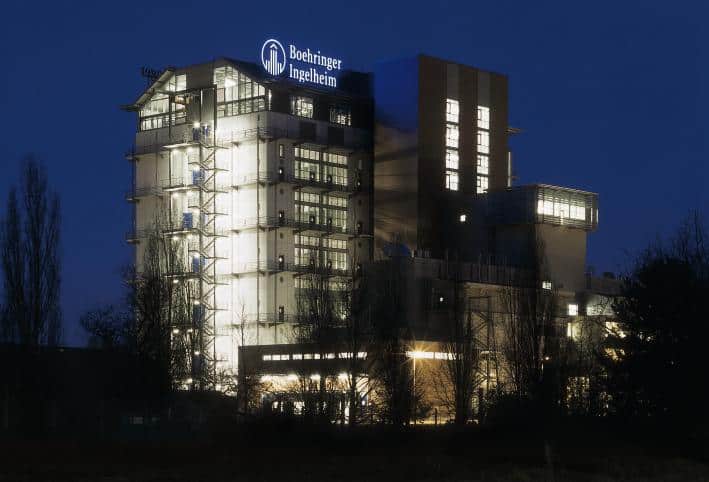
NSCLC lift for Boehringer
pharmafile | June 4, 2013 | News story | Research and Development, Sales and Marketing | Boehringer, NSCLC
Boehringer’s pipeline has been boosted with the news that its investigational oral triple angiokinase inhibitor nintedanib plus chemotherapy, extends the life of lung cancer patients with adenocarcinoma when used as a second-line treatment.
This is a hard-to-treat group, and the LUME-Lung 1 results are the first promising findings in almost a decade in terms of overall survival for patients where initial chemotherapy has failed.
Nintedanib blocks three growth factor receptors: vascular endothelial (VEGFR 1-3), platelet-derived (PDGFR alpha and beta) and fibroblast (FGFR 1-3) – a range which could put it ahead of the field.
When added to docetaxel chemotherapy, nintedanib extended life by 2.3 months for non-small cell lung cancer (NSCLC) adenocarcinoma patients when compared to placebo plus docetaxel.
NSCLC accounts for 85% of all lung cancers, and overall survival was improved 12.3 months in the nintedanib arm, versus 10.3 months, while the primary endpoint – progression-free survival – in the nintedanib plus docetaxel arm was 3.4 months versus 2.7 months for those treated with placebo, regardless of tumour histology.
“This is the first time an anti-angiogenic treatment has shown a real benefit for NSCLC patients after initial chemotherapy has failed,” said LUME-Lung 1’s principal investigator Martin Reck, who is also head of thoracic oncology at Germany’s Lung Clinic Grosshansdorf.
“It is important to understand that NSCLC patients have a very poor prognosis as their tumour will inevitably progress after first-line treatment,” he added. “Nintedanib may therefore provide a much-needed new option for treatment.”
There are many types of lung cancer, of which adenocarcinoma is the most common – accounting for almost half of all NSCLC – which is part of the reason why this is such a competitive therapy area: Merck’s lambrolizumab, which targets programmed death receptor (PD-1), is currently being evaluated in patients with this condition.
Nintedanib is being investigated in patients with various solid tumours: as well as NSCLC, there is ovarian, liver, kidney and colorectal cancer.
Boehringer has also been testing nintedanib in the fatal respiratory disease idiopathic pulmonary fibrosis (IPF), an indication for which the FDA has already awarded the drug orphan designation.
The investigational drug targets growth factor receptors which are potentially involved in the development of IPF, and the Phase II TOMORROW trial demonstrated a positive trend in reducing lung function decline in IPF patients treated with 150 mg of nintedanib twice-daily compared to placebo.
Last year Boehringer filed afatinib in Europe in lung cancer, after its Phase III LUX-Lung trials suggested it was superior to best-in-class chemotherapy (pemetrexed and cisplatin).
It could challenge Roche’s blockbuster oral treatment Tarceva, which is also a tyrosine kinase inhibitor that targets the EGFR receptor – although afatinib is an advance over its ‘first generation’ EGFR rival in that it blocks a wider range of targets, and is the first irreversible blocker.
Adam Hill
Related Content

iOnctura expands clinical trial programme for NSCLC
iOnctura has announced the expansion of its clinical trial programme for its lead pipeline asset, …

AstraZeneca shares results from phase 3 TROPION-Lung01 trial
AstraZeneca has announced results from the phase 3 TROPION-Lung01 trial of AstraZeneca and Daiichi Sankyo’s …
FDA approves J&J’s Rybrevant with chemotherapy for NSCLC treatment
Johnson & Johnson have announced that the US Food and Drug Administration (FDA) has approved …