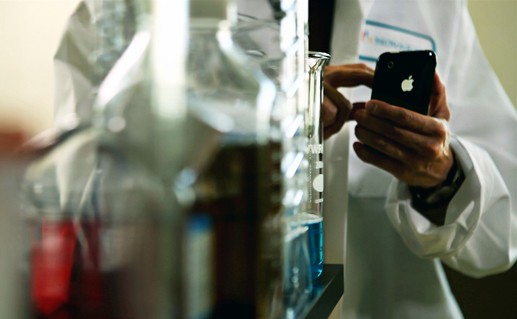
Novartis enters digital tech collaboration
pharmafile | January 12, 2015 | News story | Sales and Marketing | Novartis, clinical trials, digital, mhealth, qualcomm, ventures
Novartis has entered an agreement with the US investment company Qualcomm Ventures to create a joint firm to support the digitalisation of clinical trials.
The $100 million collaboration will focus initially on assisting early-stage companies with technologies, products and services.
“By working with Qualcomm Ventures, Novartis sees the opportunity to take a greater leadership role in introducing new mobile or digital technologies that have the potential to change the practice of medicine and bring more breakthroughs with real benefits to patients and society,” comments David Epstein, who is the division head at Novartis.
Novartis will use the investment firm’s wireless technology provider ‘2net Platform’ to collect medical data directly from trial participants in their homes.
Selected for the pharma firm’s Trials of the Future programme, the cloud-based offering is being used in order to give Novartis more opportunities to use mobile health (mHealth) devices in clinical trials.
“We are excited by the potential of digital medicines to further enhance our mission of the right drug for the right patient at the right time helping people live longer with a better quality of life giving more time to do the things that matter to them,” adds Epstein.
The principal trial in the new partnership has already begun – evaluating the use of mobile devices for patients with chronic lung conditions. In an observational trial that didn’t include any Novartis products, mobile-enabled smartphones and hubs were used to collect biometric data from medical devices.
Rick Valencia, the senior vice president and general manager of the investment firm’s Qualcomm Life, says: “Standardising on the tech-agnostic 2net Platform and accessing the robust ecosystem of integrated medical devices will provide them [Novartis] a great range of flexibility and scalability, ultimately accelerating their efforts to design more efficient, cost-effective clinical trials.”
Various new technologies seem to be increasingly emerging that aim to offer much in the field of robust pharmacoeconomic analyses: such as mobile apps, wearable devices, and data technologies.
This type of technology is expected to make a significant difference to the pharma industry over the next decade, but still leaving plenty to do to fully ‘digitalise’ the healthcare industry as much as some observers would like.
Not being the only pharma offering to experiment with the digitalisation of clinical trials of course, GlaxoSmithKline trialled mHealth devices last year as part of a bid to speed up the process and capture data more effectively.
Working with US firm Medidata, GSK gave people wearable devices to measure vital signs, electrocardiogram (ECG) data and activity levels.
The idea was to integrate digital technology to see whether it would align site and patient needs with faster study execution, thereby saving money.
Tom Robinson
Related Content

Scotland starts newborn screening for SMA
As part of a two-year evaluation funded by the Scottish government and Novartis, Scotland will …

Novartis receives SMC approval for early breast cancer treatment
Novartis has announced that its treatment for early breast cancer, Kisqali (ribociclib), has received approval …

Vesper Bio reports positive topline results for dementia candidate
Vesper Bio, a clinical-stage biotech developing novel oral therapies for neurodegenerative and neuropsychiatric disorders, has …