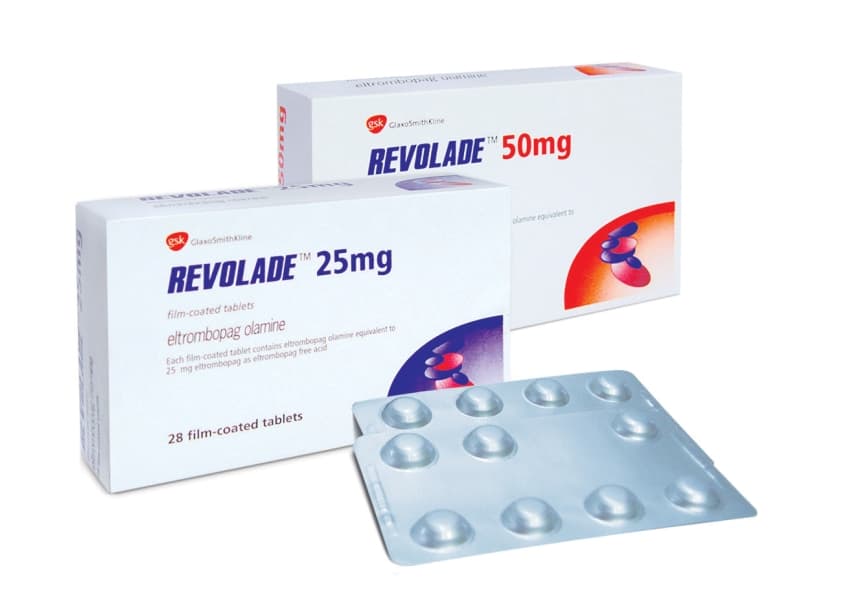
NICE thumbs-up for Revolade
pharmafile | June 12, 2013 | News story | Sales and Marketing |
GlaxoSmithKline’s once-daily pill Revolade may be used to treat NHS patients who have a rare blood disorder, according to final draft guidance from NICE.
The watchdog has recommended that Revolade (eltrombopag) should be available for some adults with chronic immune (idiopathic) thrombocytopenic purpurai (ITP) – a final decision is expected next month.
The news is a big step forward for GSK: NICE rejected the drug three years ago because it was sceptical of its benefits over existing treatments such corticosteroids and immunoglobulins.
At that time the annual cost of the drug was cited as being between £22-33,000, but GSK has now fallen in line by agreeing to a patient access scheme to bring Revolade into NICE’s orbit.
If given the nod it would join Amgen’s Nplate (romiplostim), which NICE approved for this patient group in 2011.
Caused by abnormally low levels of platelets which are needed for the blood to clot, ITP affects around 3,500 people in England and Wales, and is more common in women and in older people of both sexes.
Revolade is licensed for use in adults with ITP who have had a splenectomy, and whose condition does not respond to other treatments, and as a second-line treatment in those for whom surgery is not advisable.
NICE’s recommendation covers both groups but only if they have severe disease and a high risk of bleeding that needs frequent courses of rescue therapies.
Most adults with ITP do not have symptoms, which means the problem is usually diagnosed after an unrelated, routine blood test. Removing the spleen – part of the lymphatic system – is recommended in some cases because this can increase the platelet count.
“People who have chronic ITP are at daily risk of nosebleeds or other bleeding that is hard to stop,” explained Professor Carole Longson, NICE’s Health Technology Evaluation Centre director.
While it is not usually fatal, there is a small risk of life-threatening intercranial haemorrhages.
Recommended initial dose is 50 mg daily, and this may rise to a maximum of 75 mg once-daily, although treatment should be stopped if the platelet count does not increase sufficiently to avoid clinically significant bleeding after four weeks at this higher dose.
Adam Hill