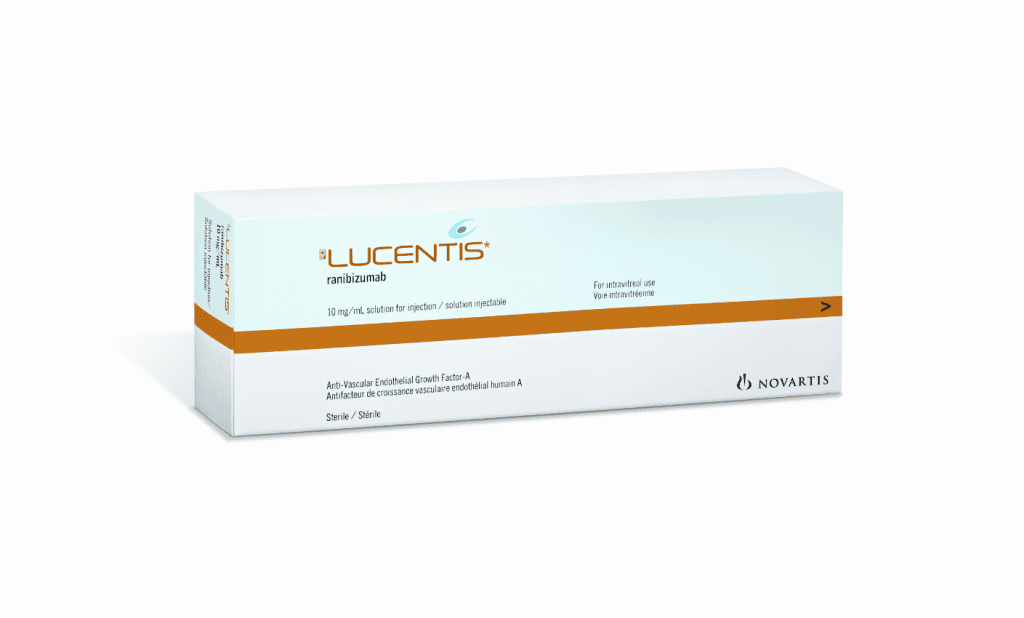
NICE gives Lucentis more scope
pharmafile | November 27, 2013 | News story | Sales and Marketing | Lucentis, NICE, Novartis, cnv
An undisclosed price cut from Novartis has been enough to swing NICE towards using the manufacturer’s Lucentis in a fourth eye condition on the NHS.
In final guidance, the watchdog has recommended the anti-vascular endothelial growth factor A treatment as an option for sight problems caused by choroidal neovascularisation (CNV) in people with pathological myopia, a rare form of short-sightedness.
The chronic condition is characterised by excessive lengthening of the eye and degenerative changes at the back of the eye, which can cause blood vessels to leak or bleed into the retina – a process known as CNV.
Lucentis (ranibizumab) is already a staple of NHS eye therapy, approved by NICE and the Scottish Medicines Consortium to treat visual impairment due to macular oedema secondary to retinal vein occlusion (RVO), and due to diabetic macular oedema (VI-DMO) and wet age-related macular degeneration (AMD).
The aim of the current management of CNV is to protect or improve clarity of vision – loss of central vision is often the outcome for sufferers – but Lucentis can now be used as an option, blocking the action of VEGF-A and thereby preventing abnormal blood vessels developing.
This should help limit visual loss and improve vision: around a third of people who develop CNV in one eye will develop it in the other within eight years, and around 200,000 people in the UK have pathological myopia.
Novartis has been under sustained pressure from the NHS to lower prices – and the appearance of a competitor in the shape of Bayer’s Eylea (aflibercept) has also concentrated the manufacturer’s mind.
Administered as a single intravitreal injection of 0.5 mg, the list price of Lucentis 10 mg/ml is £742.17 per 0.23-ml vial – but it is not known what the patient access scheme will bring this down to.
Professor Carole Longson, health technology evaluation centre director at NICE said: “This condition can cause sight problems such as distorted vision, colour disturbance and even sight loss. These symptoms can come on suddenly, and may lead to irreversible damage to the eye, so this decision will be welcome news to all those affected.”
Adam Hill
Related Content

Scotland starts newborn screening for SMA
As part of a two-year evaluation funded by the Scottish government and Novartis, Scotland will …

Digital mental health technologies – a valuable tool in supporting people with depression and anxiety
The potential benefits of digital mental health technology for managing depression, anxiety and stress, together …

Novartis receives SMC approval for early breast cancer treatment
Novartis has announced that its treatment for early breast cancer, Kisqali (ribociclib), has received approval …