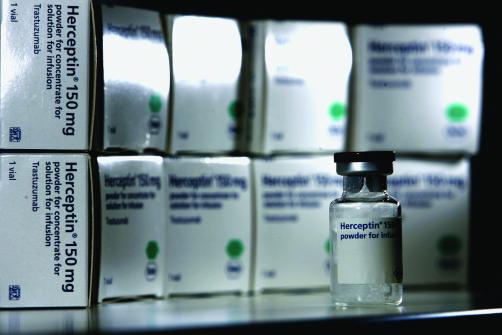
New data shows Herceptin’s ability to increase survival
pharmafile | April 24, 2012 | News story | Research and Development, Sales and Marketing | Cancer, Cochrane, Herceptin, Roche, breast
A new review of Roche’s breast cancer drug Herceptin has confirmed its ability to increase overall survival, but concerns remain over its side effects.
The review was undertaken by Cochrane and involved a meta analysis of eight studies involving 12,000 women with HER2-positive operable breast cancer, who were randomly assigned to receive Herceptin or standard chemotherapy.
Clinicians then followed the women for an average of three years during and after treatment, and the study found that Roche’s drug significantly reduced recurrence and mortality in the women.
The drug was found to also significantly improve over survival in HER2-positive women with early and locally advanced breast cancer.
But some patients in treatment developed severe heart toxicity (congestive heart failure).
The review said that the drug reduced breast cancer mortality by one-third, but the risk of heart toxicity is five times more likely for women receiving Herceptin than women receiving standard therapy alone.
The review’s authors said that if 1,000 women were given standard therapy alone (without Herceptin) then about 900 would survive and five would have experienced heart toxicities.
If 1,000 women were treated with standard chemotherapy and Herceptin for one year, about 933 would survive (33 more women will have their lives prolonged.
About 740 would be free of disease recurrence (95 more women will not experience the disease return), and 26 would have serious heart toxicity (21 more than the chemotherapy alone group) due to the drug.
The authors noted however that heart toxicities are often reversible if the treatment is stopped straight away.
The review said that longer treatment (over a year) with Roche’s drug “might involve a greater risk of severe heart toxicities than shorter treatment” (six months or less).
The authors concluded that the balance of risks to benefits in patients at lower risk of recurrence (e.g., a small rather than a large tumour) must be carefully evaluated before treatment is started.
Ben Adams
Related Content

Roche adds 2,176 NVIDIA Blackwell GPUs to its hybrid-cloud AI factory
Roche has expanded its global AI infrastructure with a NVIDIA AI factory, adding 2,176 high-performance …

Central nervous system cancer metastases – the evolution of diagnostics and treatment
The current forms of immunotherapy, how T cell therapy works and what the future holds
Roche receives CE Mark for blood test to help rule out Alzheimer’s
Roche has been granted CE Mark approval for its Elecsys pTau181 test, the first in …