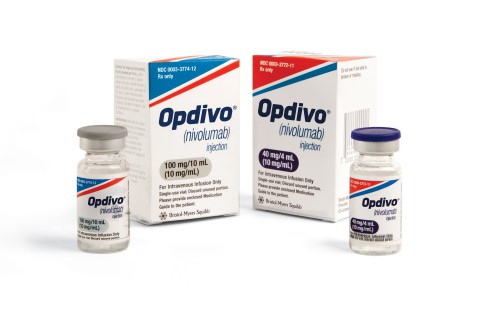
Failure for BMS’ Opdivo in lung cancer trial
pharmafile | October 10, 2016 | News story | Research and Development, Sales and Marketing | BMS, MSD, Roche, clinical trial failure, keytruda, opdivo, tecentriq
Disappointing news for Bristol-Myers Squibb as the company announced that its blockbuster drug Opdivo (nivolumab) failed to meet its primary endpoint in a new trial investigating the drug’s efficacy in significantly prolonging progression-free survival (PFS) versus chemotherapy.
The trial examined 541 patients with advanced squamous or non-squamous non-small-cell lung cancer (NSCLC) who had not previously received treatment for advanced disease and whose levels of PD-L1, a protein which is often used as an accurate gauge of immunotherapy suitability, was at least 1%. The results, revealed at the European Society for Medical Oncology (ESMO) congress, showed that median PFS for those with at least 5% PD-L1 expression was 4.2 months, notably lower than 5.9 months with chemotherapy. Overall survival was 14.4 months for Opdivo versus 13.2 for chemotherapy; 60% of those treated with chemotherapy received Opdivo following progression through crossover or commercial access.
Analysts called the results “below expectations”, but the company was quick to note that various factors, such as more women and more patients with high PD-L1 levels in the chemotherapy arm, may have distorted the findings. BMS’ development lead for lung cancer Nick Botwood commented: “The study was designed to ask a very specific question at the 5% expression, it wasn’t designed to ask a question at 50%.”
Elsewhere, both Roche’s Tecentriq and MSD’s Keytruda reported successful trial results as they now move further into Opdivo’s territory in the lung cancer space.
“We thought Opdivo could beat chemotherapy, and we have answered the question…for the broad population it is not enough,” remarked Fouad Namouni, head of oncology development at BMS. Namouni further suggested that combination treatment of Opdivo and BMS’ immune-based treatment Yervoy (ipilimumab) could potentially be more effective in this setting, but a large study will not be completed until 2018.
Matt Fellows
Related Content

BMS’ Opdivo/Yervoy combination accepted by Scottish Medicines Consortium for colorectal cancer
Bristol Myers Squibb (BMS) has announced that its Opdivo (nivolumab) has been accepted, in combination …

Roche receives CE Mark for blood test to help rule out Alzheimer’s
Roche has been granted CE Mark approval for its Elecsys pTau181 test, the first in …

Roche candidate shows early promise for treating haemophilia A
Roche has announced encouraging early results from its phase 1/2 trial of NXT007, an investigational …