Atomic structure of tau revealed opening up new Alzheimer’s targets
pharmafile | July 6, 2017 | News story | Research and Development | Alzheimer's disease, dementia, tau protein, tau tangle
It is a research breakthrough that has been touted as the biggest development in Alzheimer’s disease research for a quarter of century – scientists have revealed the atomic structure of abnormal tau protein.
Tau proteins are integral to healthy brains, providing support to stabilise microtubules. However, when these proteins become abnormal, they have been found to have a strong correlation with Alzheimer’s and Parkinson’s disease.
In the brains of those suffering from Alzheimer’s disease, the tau proteins are found to bind together, known as tau tangles, and the more evidence of such build-ups, the worse the symptoms of the disease are found to be.
The work was carried out by the MRC Laboratory of Molecular Biology, after scientists were to use brain tissue from a 74-year-old woman who died after having Alzheimer’s disease.
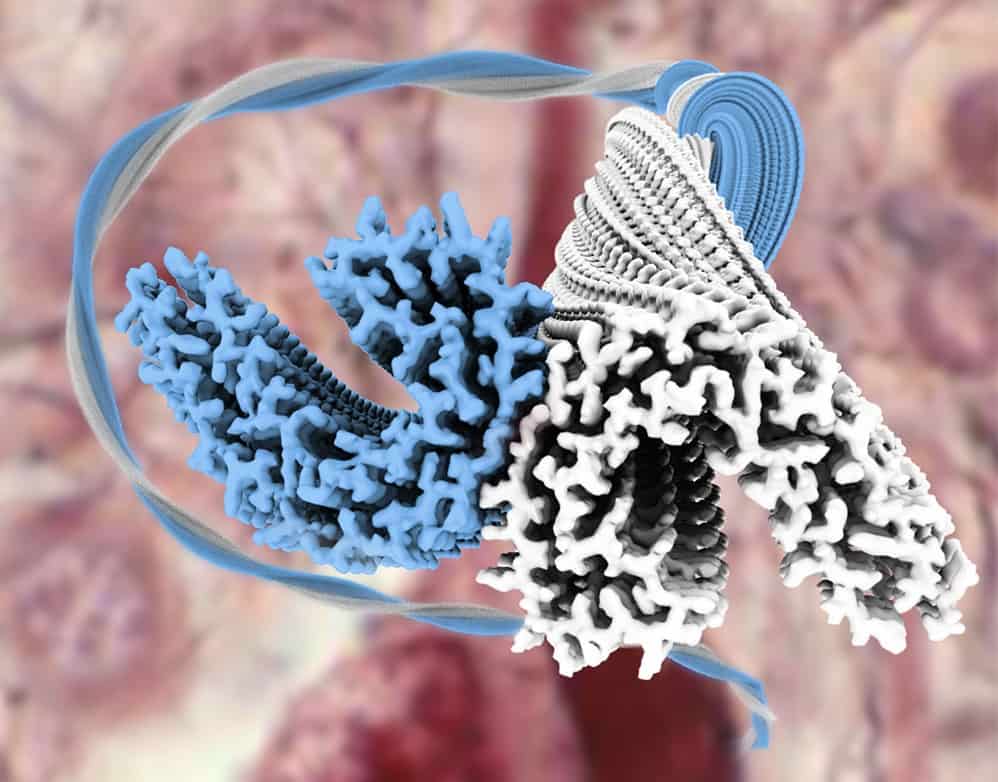
The tau were analysed through a technique called cryo-EM, which involves cooling a sample of the protein to sub-zero temperatures to eliminate any structural changes. The samples were then examined by an electron microscope before computer software was able to identify the structure of tangles, seen in the image at the beginning of the page.
Knowing the precise structure of the tau tangles could open up new means of treating the disease and developing potential drug targets. Dr Rosa Sancho, Head of Research at Alzheimer’s Research UK, explained why this was now a possibility: “A build-up of tau protein is a feature of a number of different degenerative brain diseases, and this work could help to answer key questions about why it starts to behave unusually and how it leads to such a wide variety of conditions. As well as improving our understanding of diseases like Alzheimer’s, knowing the precise structure of tau will help inform research into new treatments.
“Drugs that could clear away clumps of protein in the brain are a key goal for researchers, but to directly affect these proteins, molecules that make up a drug need to latch on and bind to their surface. Knowing the precise shape of these complex protein structures is enormously valuable in guiding the development of targeted drugs.”
The development of new drugs is particularly important, as the number of people living with neurodegenerative disorders continues to rise – alongside an ageing population. At present, there are currently no treatments that can reverse the condition, only those that are able to slow progression or improve symptoms.
Ben Hargreaves
Related Content

Vesper Bio reports positive topline results for dementia candidate
Vesper Bio, a clinical-stage biotech developing novel oral therapies for neurodegenerative and neuropsychiatric disorders, has …

Sanofi completes acquisition of Vigil Neuroscience to early neurology pipeline
Sanofi has announced that it has finalised its acquisition of Vigil Neuroscience, a US-based biotechnology …

Lilly’s drug for early Alzheimer’s shows promising results
Eli Lilly (Lilly) has announced positive new data from the long-term extension of its phase …