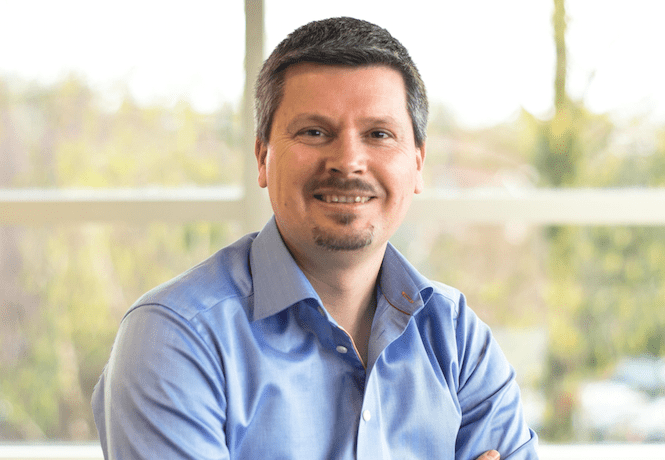
Working Life: GE Healthcare’s Emmanuel Ligner
pharmafile | April 22, 2014 | Feature | Business Services, Manufacturing and Production, Medical Communications, Research and Development, Sales and Marketing | GE Healthcare, Working Life, emmanuel linger
How did you find your way into your current role?
There have been various circumstances in my professional career that brought me to where I am today. When asked socially, I usually say that I would not be doing what I am now if I had not decided to go and live in Japan – something I decided to do straight after university.
It may sound unusual, but I have always viewed myself as a product and thought: ‘How can I differentiate myself?’ One of the most important things which I think sets a person apart is experience.
When growing up, I was encouraged to take my own path and do things differently, so it was logical for me to take my backpack and go to Japan, study Japanese and to work there for 10 years. I knew this would give me an experience which would single me out from the crowd.
The second factor that led me to my current role is my love of the commercial world. I enjoy everything about it: crunching the numbers every month; going out, growing the business; closing the deal, and the win. I don’t believe you can be a commercial leader if you don’t like those things.
Japan was a great place for me to cultivate my skills and I spent my 10 years in various commercial and marketing roles for both Japanese and locally-based US pharmaceutical organisations. Although successful in my roles, I was aware that I didn’t want to become pigeon-holed as a Japanese market specialist.
I knew there was a risk this would happen if I stayed in the country for too long, so I sought new challenges abroad and when an opportunity arose to join a small company in 2004, I jumped at it and moved to the UK to work for Whatman.
I was part of the Whatman team for four years and was able to play an integral role in the sale of the business to GE Healthcare Life Sciences. Joining GE, I found myself part of a very exciting, dynamic group of people from whom I could learn, which I think is important.
Another reason why I am where I am today is that I am a very loyal person – once I like working for a boss, I am comfortable in my role and will stay, happy working for them. I found this with Kieran Murphy when at Whatman and it’s one reason why I have stayed at GE fulfilling ever evolving roles.
When GE created its research consumables division, I headed up this business in Europe and after that I was asked to move to the US to manage the BioProcess business there, overseeing our commercial relationships with customers in the biopharmaceutical manufacturing industry.
It was the first time I had been involved in this particular market and it opened opportunities for me to develop further. In 2012, I came back to the UK as the commercial head for the entire GE Healthcare Life Sciences business in Europe, the Middle East and Africa.
How is your field changing?
As with many industries, globalisation is becoming more and more present in day-to-day business. For example, I’ve been with customers in California and received feedback on our service engineers working at their site in Switzerland. You realise the community is very small and what happens on one side of the Atlantic is very quickly known on the other.
This is a trend I’ve observed over the last 20 years or so and it can be tricky for companies who don’t have the right structure to handle it.
What are the most enjoyable things about your role?
We are evolving an exciting consultative approach to selling and this is part of the role I find enjoyable. I like that we are able to help our customers with insights and experiences which we can share, by developing commercial teams that are able to readily talk about our technologies while keeping in mind the bigger picture, understanding the customers’ broader needs and advising on more complete solutions.
What are the most common misconceptions about your field and the people in it?
One misconception may be that to sell a high-end technical, scientific-based product, all you need is to be deeply technically qualified. Of course, it is incredibly important to have a deep understanding of the technologies and customer needs, but another set of skills is required either in the same person or in another team member, and that is commercial expertise.
For example, a customer may be a large pharmaceutical company with more than 300 pieces of equipment due for renewal in the next two to three years. Beyond talking about the science of new products, we would perhaps discuss a replacement-phasing strategy for the next three years in which a number of instruments a year would be replaced, financing options, productivity gain, implications for service contacts, training programmes for employees and potential buy-back of instruments.
That is not science but is hugely significant to the customer as it helps them meet their commercial pressures.
Is there someone in your field who has inspired you or from whom you have
learnt a lot?
As I mentioned before, I am very loyal to Kieran from my days working with him at Whatman and now at GE. Kieran is a very authentic leader which is one reason why I enjoy working with him.
Another person from whom I learned a lot is Klaus Juelicher, the first non-Japanese board member of the Japanese pharma company Otsuka Seiyaku, Otsuka Pharmaceutical.
Klaus always told me to be myself: don’t try to imitate someone; don’t try to wear an armour or costume every morning that you go to the office, just be yourself; the more you are yourself, the better it is.
Similarly, is there someone (or something) outside your field who has been a source of inspiration for you?
My family are another source of inspiration to me, in a different way to those who have given me professional inspiration within my field. We all work in similar healthcare fields in very different capacities but want to experience different things in life.
My father was a pioneer osteopath in France, associating osteopathy and acupuncture, and my mother is very energetic, always driving for perfection. Many of my family don’t speak good English, have never really moved from where we were born but they have been important to me in that they have always given me a strong anchor, helping me to become more international.
What is the secret to a happy working life?
Having fun! Working with a very close circle of people who you know well leads to a happy working environment. I share everything with my human resources manager, CFO and marketing managers. I moan when I have to moan, and joke when I can joke and am able to do this because we have a strong feeling of trust. We do have a lot of fun working together!
Support at home is also extremely important, my wife Kiyomi and I were counting recently that we have already moved house nine times together. Her support gives me the confidence and freedom to push ahead.
If you had any advice for someone starting out in your field now, what would it be?
At the start of the interview, I said I always view myself as a product, how can I differentiate myself from the next person? It’s important and I think it is even more so now that ever. I feel old saying this, but when I started 20 years ago, I was told it was very important to speak English – in reality, it wasn’t important it was a necessity; a bare minimum.
Colleagues who graduated from French business schools spoke English, German or Spanish in addition to native French but at that time, no one was speaking Japanese. That’s why I decided I would experience Japan and learn Japanese – it would be my safety net, my differentiator.
I would encourage people to seek out new experiences and cultures. Those who “take a backpack to somewhere new” do think differently, meet new people and have unique experiences.
These experiences and qualities are very attractive – when we look to hire people, we don’t think only about their capabilities for that particular job, but are already thinking ahead one, two, three positions in the future.
So to link back, when I started my career in Japan I found I was particularly successful in forming really solid relationships with customers because I was both empathetic to their viewpoint and had, through my various experiences, found a way to connect with people, telling them stories that made them interested in having conversations with me. From then on, this approach has played a key role in my career on many levels.
Related Content

Working Life Interview: Fiona Huzarski, Vice President of Global HR, ADVANZ PHARMA
“Every company is different, so you have to be open-minded and receptive to the culture …
Working Life Interview: Kim Stratton, CEO, Orphazyme
“Every professional faces challenges. As a woman in industry, particularly in leadership, it adds another …

Working Life Interview: Dr Andrea Pfeifer, Co-Founder and CEO, AC Immune
What originally set you off on your career path? Was the plan always to go …