PROFILE: Ambitious Ferring wants to be global fertility leader
pharmafile | October 7, 2015 | Feature | Manufacturing and Production, Research and Development | Ferring, peptides
The stunning view of the Alps across Lake Geneva from Ferring’s corporate headquarters in Saint-Prex seems appropriate for a company aiming high, as it targets a future for itself as the leader in reproductive health.
Ferring is a company proud of its history and achievements thus far- as evidenced by the huge mural on the wall of its HQ’s impressive entrance hall, displaying the chemical structures of its most successful compounds- but this doesn’t prevent it from being forward-looking.
The multi-purpose facility, completed in 2006, provides additional production capacity for Ferring’s dry product range, as well as secondary packaging and distribution of all products.
Looking to the future on its 65 birthday, the company was keen to throw open its doors to media to discuss its aspirations, its promising pipeline and its expansion plans in emerging markets.
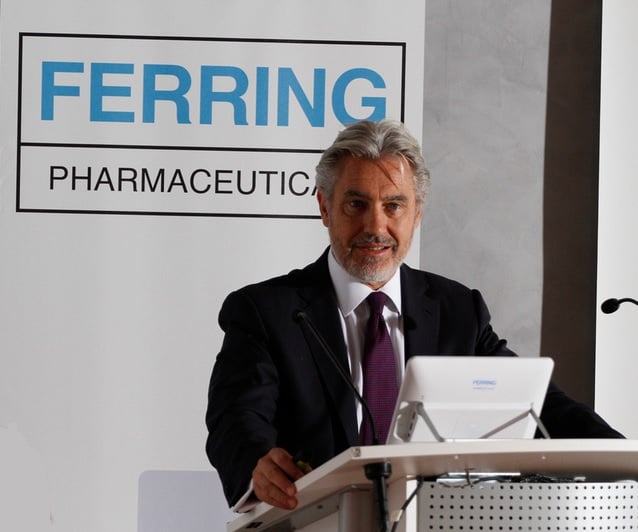
President Michel Pettigrew said that along with becoming the leader in fertility and reproductive health, “from conception to delivery,” privately-owned Ferring also intends to make large inroads into the gastroenterological market, which currently accounts for 24% of its €1.5 billion 2014 sales.
Reproductive health makes up 44% at this stage. Urology, gastroenterology, orthopaedics and endocrinology account for the majority of the remainder. Ferring has projected further sales growth to €1.8 billion in 2015.
Agility
While it may not have the huge scale of the more publicised names in big pharma, Ferring has earned considerable respect for what it does. Indeed, its smaller stature relative to the giants of the industry and the culture this enables is something that senior executives at the company believe often works to its advantage.
Chief scientific officer Per Falk joined the company from Novo Nordisk in January this year. He told Pharmafile.com: “The formalities at Ferring are less, based on both size and culture. This company thinks it is very bureaucratic and formal, but I know that is not the case. The decisions and pathways are quicker, it is easier to get agreement. We run this company like a listed company, but the ownership structure gives us an edge – for example you can gain agreement faster since you don’t have 50 boards and a million shareholders.
“You have one shareholder and you are closer to each other, so we can all make decisions faster. This has been very helpful for me, because, of course, me being here is about the future, and making sure the pipeline looks the right way for Ferring to continue to grow. It doubled its growth for a number of years in a period where most pharma companies struggled to have any growth.
“But now new molecules are needed to sustain that growth, and I believe with the pipeline we have, the best years are ahead of us. But that means we must focus in on the areas where we are strong and on the molecules in those areas that will carry this in the best possible way. The fertility segment is where we must focus our efforts.”
A passion for peptides
The now Swiss-based Ferring was founded by Swedish scientist Frederick Paulsen in 1950, who found a lucrative niche in the development of pharmaceutical products based upon natural, pituitary-produced peptide hormones, usually obtained from pigs.
Ferring enjoyed a significant breakthrough in the early 1960s, succeeding in producing the synthetic peptides oxytocin and vasopressin on an industrial scale- the first company to do so in tablet form. From vasopressin, it created the antidiuretic Minirin, which went on to be a longstanding blockbuster drug for the company.
The ‘80s saw continued expansion for Ferring and the creation of several subsidiaries in Europe, North America and South-East Asia, as well as the launch of Pentasa for the treatment of inflammatory bowel diseases as the company strengthened its hand in gastroenterology.
It followed this up in the 1990s with additional subsidiaries established in Eastern and Western Europe, South America, South Africa, Asia and the Middle-East, growing revenues steadily throughout the decade, and launching another of its most renowned fertility treatments, in Menogon.
Moving into modern times, the 2000’s saw the launch of Tractocile for premature labour and, at the end of the decade, Firmagon for advanced hormone-dependent prostate cancer.
In 2011, Ferring completed an important company acquisition: the obstetrics specialist Cytokine PharmaSciences and its subsidiary, Controlled Therapeutics Scotland, in-keeping with its aims of becoming a reproductive health leader. Michel Pettigrew has indicated that Ferring will pursue further such acquisitions to help it achieve its strategic goals, but in doing so will carefully consider risk versus reward due to the “crazy” sums often involved in the modern pharma acquisitions.
The company built the success that makes its strong position a reality upon its leadership in peptides, and the hormones are still widely used in Ferring’s products today. Even as the company grows, its moves in the market are still informed by its heritage.
As Pettigrew puts it, “the science takes precedence,” and indeed the complexity of Ferring’s science and manufacturing processes means many of its off-patent products are still seeing sales growth to this day, with copycats proving hard to create.
Pipeline
The consistent growth Ferring has achieved over the years has allowed it to extend its therapeutic reach, but focusing its attentions and resources has proven a successful strategy. Looking to the next decade, the company is keen to continue in the same vein, expending its manpower wisely on the most promising products in its pipeline.
Falk comments: “Since joining Ferring, I think we have come a long way as an R&D team and a company in defining what in our pipeline really matters for the company in the next 10 years.
“We will of course look at other innovation, but a part of cleaning the pipeline up: focus on the right thing and you open up for new things to enter, because otherwise you just clog the pipeline with hundreds of things that you just linger on. This has been the most important part of my first eight months.
“We’ve had some really good breakthroughs and discussions with the regulatory officials in the US that have helped us to define where our best opportunities are. And this enabled us as a team to take some very tough decisions regarding what to pursue and what not to pursue. That will help us a lot going forward.”
Ferring currently reinvests 16% of its revenue into R&D, more than half of which goes into its priority areas of reproductive health and urology. It currently has 14 major strategic collaborations active, perhaps the most high-profile of which is with Roche on the follicular-stimulating hormone Rekovelle, which Falk says is delivering encouraging phase 3 data.
He comments: “We work with some really large organisations and universities across the world in our Ferring Research Institute in California, which is basically the discovery platform of Ferring. There are a number of big interactions, including the Salk Institute, and it is actually this collaboration which gave rise to Firmagon.
“In Europe, we also have large collaborations with the Pasteur Institute, looking at new ways of treating Inflammatory Bowel Disease. That also includes investigators at the University of Lille, and in the US at Mount Sinai Hospital in New York and also biotech in the US.
“We have a lot of scale; everything from our traditional long-term collaborations where we use different technology platforms for formulation work for developing a specific molecule to basically spearheading new science. And we see across the board that we are covering these areas. We can do more, but I believe that for a company of Ferring’s size, we are very open to initiating new activities and putting things out.”
Future
Such collaborations will only advance Ferring’s goals as it enters what could be the most lucrative phase in its history. Pettigrew says the company wants to become more balanced and global, as well as having a stronger regional presence, and it is expanding its capabilities in several markets: targeting in particular the US, Japan, China, Brazil and India with a view to creating a “lean and agile global network”.
Ferring will commence work at a new €25 million commercial and manufacturing facility in Mumbai, India in 2016, and intends to create a fully-integrated company in the country. This follows the 25-acre US Operations Centre already established in New Jersey late last year, and other existing R&D centres in the US, Israel, China, Scotland, Denmark and Japan.
Falk said the company will continue to examine additional growth markets, including North Africa, Algeria, Turkey, and South East Asian countries like Malaysia.
He explains: “The challenge in such countries from an R&D perspective is how we actually use them. You have to consider the strengths of each region. They each have different profiles we can use for long-term growth of the organisation, but we have to be very cautious and sensitive to local needs and conditions.”
Regarding products, Falk looks forward to Rekovelle’s European launch in 2016, along with the submission of data to other countries worldwide, the initiation of phase 3 trials in the US, and obtaining a clearer picture of the best strategy for the product in China and Japan.
He continues: “We will have a clear indication of two other submissions here in Europe, where we will find out, hopefully by the end of next year whether they are approved: our liquid ZOMACTON growth hormone, and in the US a testosterone product, Testavan, which will be important for those regions.
“We will also have good progress in our septic shock care programme, which is the single biggest one we have: within the intensive care sector.”
Joel Levy
Related Content

MetP Pharma releases positive data on intranasal semaglutide administration
MetP Pharma has released new data highlighting the advantages of its MetP technology in delivering …
Amferia closes €1,2 million investment to combat resistant bacterial infections
Swedish medtech company Amferia announces the successful completion of its latest investment round, boosting its …

PeptiDream and Novartis extend peptide discovery collaboration
PeptiDream has announced the expansion of its peptide discovery collaboration with Novartis Pharma AG.