New molecular-binding technique promises accelerated drug development
pharmafile | December 5, 2016 | News story | Research and Development, Sales and Marketing | Alzheimer's, Cancer, Indiana University-Purdue University Indianapolis
Researchers at the School of Science at Indiana University-Purdue University Indianapolis (IUPUI) have claimed to have designed a new molecular binding technique which could considerably accelerate drug development times and potentially cut costs.
The synthetic technique is an organic chemical process that is more streamlined than past methods, involving fewer steps to achieve results, and could lead to new drug development as well as new generations of existing treatments by abridging human and animal trial processes. It is utilised in the production of compounds containing nitrogen, which covers 75% of all medicinal compounds.
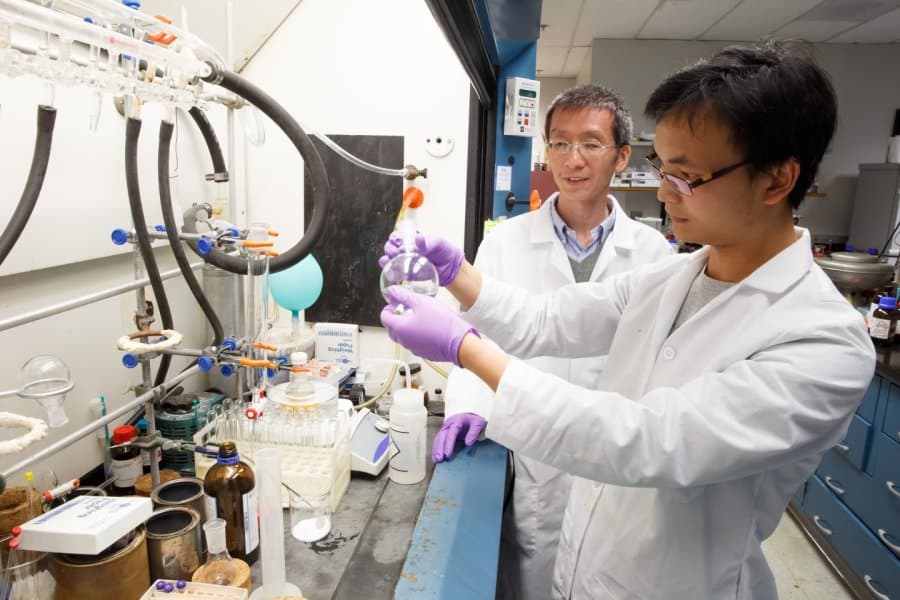
“Having fewer steps and simpler chemical ingredients, as our method does, has potential benefits both for the pharmaceutical industry and for patients,” said Haibo Ge (pictured, left), co-author of the study and associate professor of chemistry and chemical biology. “Our study showed that our technique is an advancement over the currently used method. While we are still at an early stage, it appears that in addition to improving the process of synthesizing molecules, our improved method makes that process more economical by saving time and labour. As it is “atom efficient,” there is less waste needing disposal.”
The research was detailed in “Site-selective C-H arylation of primary aliphatic amines enabled by a catalytic transient directing group”, authored by Ge and Yongbing Liu (pictured, right).
Partha Basu, chair and professor of chemistry and biological chemistry at IUPUI, further explained the importance of the find: “Hydrocarbons — compounds made out of carbon and hydrogen or having a carbon-hydrogen bond — are used in daily life all the time — from clothes to toothbrushes. These compounds are generally stable and do not react easily with common chemicals. Transformation of one hydrocarbon to another is of immense interest for developing new materials, from drugs to energy storage.
“But making such transformation in a selective way has been a challenge for more than a century. This is what Dr Ge did using a simple but efficient process that requires fewer steps. This simplicity makes the chemistry unique, and it can have a lasting impression in the field of C-H bond activation.”
The discovery promises to have far reaching effects in the treatment of a range of illnesses including Alzheimer’s, attention deficit/hyperactivity disorders, diabetes, bacterial and inflammatory disease and even cancers.
Matt Fellows
Related Content

Lilly’s drug for early Alzheimer’s shows promising results
Eli Lilly (Lilly) has announced positive new data from the long-term extension of its phase …

Central nervous system cancer metastases – the evolution of diagnostics and treatment
The current forms of immunotherapy, how T cell therapy works and what the future holds
BioMed X and Servier launch Europe’s first XSeed Labs to advance AI-powered antibody design
BioMed X and Servier have announced the launch of Europe’s first XSeed Labs research project, …