‘Star Wars’ robot arm approved by FDA
pharmafile | May 12, 2014 | News story | Manufacturing and Production, Medical Communications, Sales and Marketing | FDA, arm, deka arm system, luke, star wars
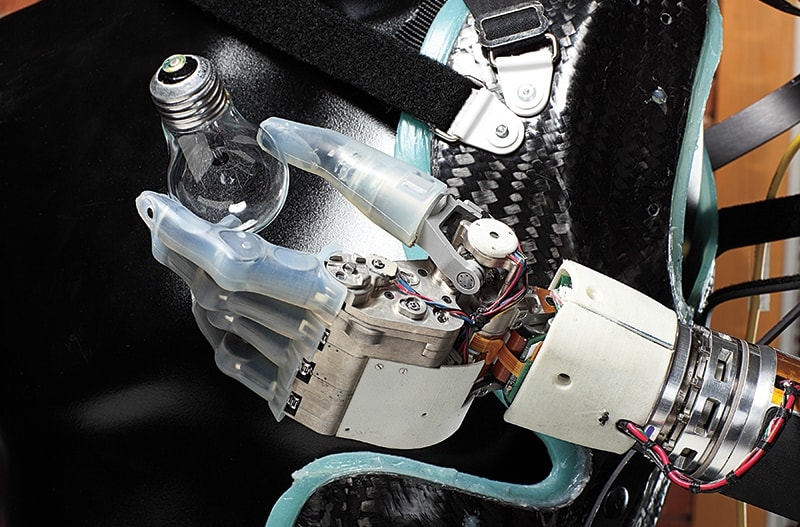
The FDA has approved a first of its kind robotic arm that can be used to make complex tasks far easier for amputees.
The DEKA Arm System is the first prosthetic arm that can perform multiple, simultaneous powered movements controlled by electrical signals from electromyogram (EMG) electrodes.
It has been dubbed as ‘The Luke’ after the Star Wars character Luke Skywalker, who in ‘The Empire Strikes Back’ film had to have an artificial limb attached after it was cut-off during a fight with Darth Vader.
The arm can perform multiple simultaneous movements, which is a huge advance over the traditional use of wielding a metal hook.
EMG electrodes detect electrical activity caused by the contraction of muscles close to where the prosthesis is attached. The electrodes then send the signals to a computer processor in the prosthesis that translates them to a specific movement, or movements.
“This innovative prosthesis provides a new option for people with certain kinds of arm amputations,” says Christy Foreman, director of the Office of Device Evaluation at the FDA’s Center for Devices and Radiological Health.
“The DEKA Arm System may allow some people to perform more complex tasks than they can with current prostheses in a way that more closely resembles the natural motion of the arm,” he adds.
The approval is based on a study that found that around 90% of trial participants were able to perform activities with the system, that they were not able to with their current prosthesis. This includes using keys and locks, preparing food, feeding oneself, and brushing and combing hair.
The DEKA Arm System can be configured for people with limb loss occurring at the shoulder joint, mid-upper arm, or mid-lower arm. It cannot be configured for limb loss at the elbow or wrist joint.
The Pentagon’s Defense Advanced Research Projects Agency (DARPA) said it provided more than $40 million in funding to DEKA to develop the robotic arm as part of a $100 million project to improve prosthetics.
Justin Sanchez, a programme manager in DARPA’s biological technologies office, tells Reuters: “It was designed to produce near-natural upper extremity control to injured people who have suffered amputations.
“This arm system has the same size, weight, shape and grip strength as an adult’s arm would be able to produce.”
Ben Adams
Related Content

FDA grants De Novo authorisation to light-filtering device for migraine
The US Food and Drug Administration (FDA) has granted De Novo marketing authorisation to Avulux, …

EndoCyclic New Drug application approved by US FDA for endometriosis treatment
EndoCyclic Therapeutics’ Investigational New Drug (IND) application for its lead programme, ENDO-205, has been approved …

MRM Health’s ulcerative colitis treatment receives FDA Investigational New Drug clearance
Microbial Resource Management (MRM) Health has announced that its lead programme, MH002, has received Investigational …