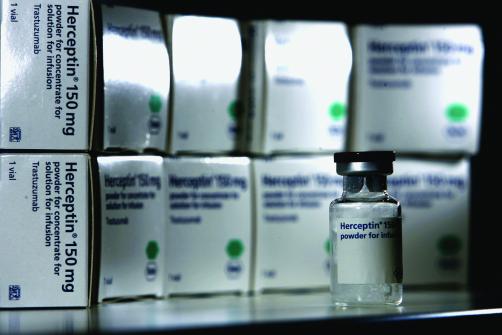
Injectable Herceptin proves its worth
pharmafile | October 20, 2011 | News story | Research and Development, Sales and Marketing | Herceptin, Roche
An injectable version of Roche’s breast cancer drug Herceptin compares favourably to the standard intravenous infusion, according to new research.
Data from the Phase III HannaH study demonstrated comparable efficacy of the investigational subcutaneous formulation of Herceptin (trastuzumab) in women with HER2-positive early breast cancer.
No new safety issues or adverse events were observed, and an anticipated marketing application to European Union regulators is expected to highlight the potential benefits to patients.
Since the injection takes only five minutes to administer, as opposed to half an hour for the IV to infuse, it may mean patients have to spend less time in hospital receiving treatment.
Roche points out that since no medicine preparation time is required, it should also ‘significantly reduce’ pharmacy time.
Hal Barron, Roche’s chief medical officer, said: “Herceptin given by subcutaneous injection has the potential to offer patients an effective, more convenient delivery option for this proven medicine.”
HannaH, an open-label study involving 596 women, met its co-primary endpoints that were trastuzumab concentration in the blood (serum concentrations) and efficacy, with secondary endpoints including event-free survival and overall survival.
Building on Herceptin’s sucess
The company is not relying solely in this therapy area on finding new means of delivering existing medicines: last month its next-generation breast cancer drug T-DM1 impressed at the European cancer congress after trumping Herceptin.
A new Phase II trial, comparing T-DM1 (trastuzumab emtansine) to Herceptin plus docetaxel chemotherapy, found patients with HER2-positive metastatic breast cancer receiving T-DM1 saw a 41% reduction in the risk of their disease worsening or death, and lived a median of five months longer without their disease worsening.
Herceptin has numerous would-be rivals and is currently up against Boehringer Ingelheim’s afatinib in the phase III LUX_Breast 1 trial.
It has held off several competitors – the latest came just last month when GlaxoSmithKline halted one of the four Phase III studies that make up the ALTTO programme for its cancer drug Tyverb.
GSK said its treatment alone was unlikely to demonstrate non-inferiority to Herceptin alone with respect to disease-free survival.
Adam Hill
Related Content

Roche secures CE Mark for automated latent tuberculosis blood test
Roche has received CE Mark approval for its Elecsys IGRA TB test, an automated blood …

Roche adds 2,176 NVIDIA Blackwell GPUs to its hybrid-cloud AI factory
Roche has expanded its global AI infrastructure with a NVIDIA AI factory, adding 2,176 high-performance …

Roche receives CE Mark for blood test to help rule out Alzheimer’s
Roche has been granted CE Mark approval for its Elecsys pTau181 test, the first in …